- Non-equilibrium Quantum Field Theory for bosonic systems
Phenomena involving quantum gases of bosons appear across different domains of physics, from Bose-Einstein condensation in cold atomic systems to ultra-light bosonic particles as promising candidates for dark matter in cosmology. Yet, a fully satisfactory description of such systems, including long-range interactions at finite temperature, is still incomplete.

Using a non-equilibrium quantum field theory formalism, with collaborators I have modelled bosonic systems at finite temperature, where a condensate (coherent phase) coexists with thermal particles (incoherent phase). Within this framework, one can recover results from established cold atom approaches, and it allows a generalization to long-range interactions.
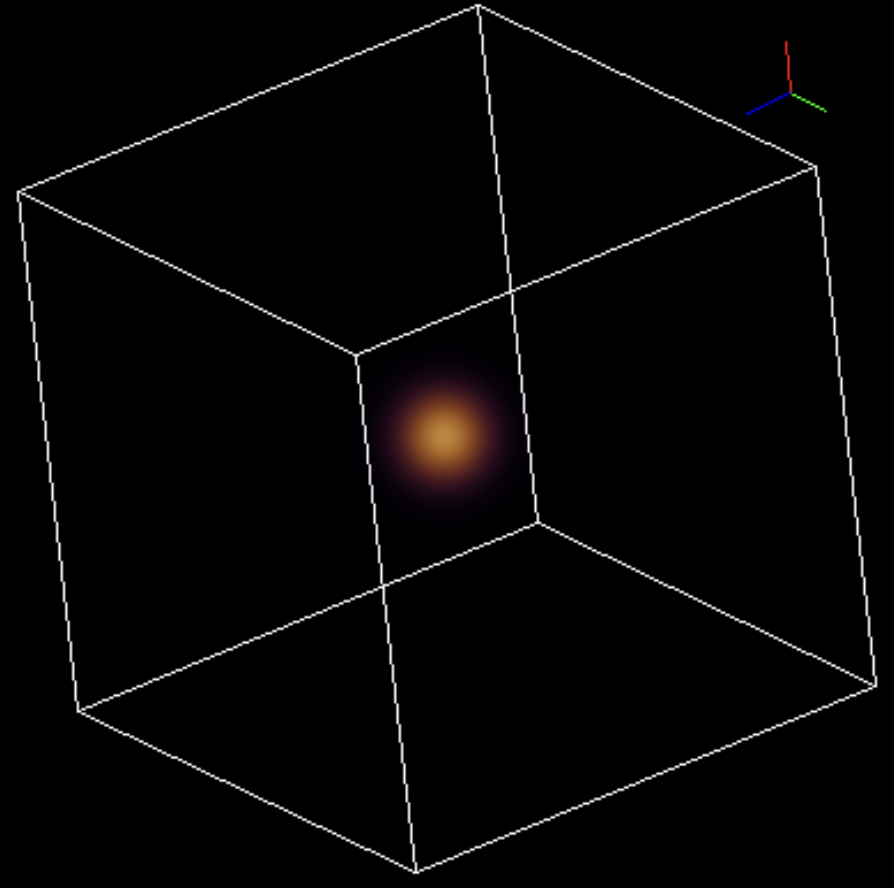
Applications of this framework include:
- Ultra-light bosonic dark matter
- Dipolar Bose–Einstein condensates
An important direction of my current research is the numerical implementation and simulation of the equations derived from this formalism.
Fundamental Tools: Schwinger-Keldysh formalism, Feynman diagrams, Wigner Transforms, Perturbative QFT, Boltzmann equation
- Gravitational sector and cosmology in Lorentz-Violating theories
The existence of a privileged direction in the universe seems highly constrained, and if it exists it should be a very small quantity. However, interesting effects arise from these tiny deviations from homogeneity and/or isotropy. There, I have explored two interesting possibilities:
- Cosmology in presence of backgrounds
Background fields in gravity have been proposed as a source of explicit diffeomorphism violation. In collaboration, we have shown that under certain conditions such backgrounds can drive an accelerated expansion of the universe without the need for dark energy.
Fundamental Tools: ADM Formalism, diffeomorphisms, cosmological measurements
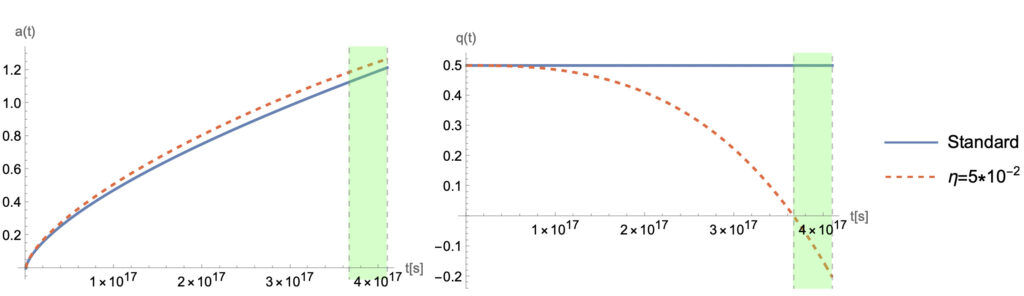
- Very Special Relativity
In this framework, nature’s fundamental symmetry is not the full Lorentz group but a subgroup, like SIM(2). A remarkable consequence is the natural emergence of neutrino masses without introducing extra particles, which is particularly attractive given the lack of new particle discoveries in colliders. I have explored this setup analyzing the possibility of mass generation for gauge bosons, such as the photon, while preserving gauge invariance. In addition, VSR provides a framework to study a massive graviton with the same degrees of freedom as the standard one but with a tiny mass.
Fundamental Tools: Gauge field theories, non-covariant gauges, perturbative QFT