The beginning of Jesus’ ministry in the year 27 AD starts with His baptism, after which He is driven or led by the Spirit into the wilderness, as noted in Matthew 4:1, Mark 1:12, and Luke 4:1. It is interesting that, before engaging in other activities of His ministry, we encounter this event, which reveals an important part of His work on Earth. His life prior to His death on the cross is just as significant as His death itself. In this account, we can see that Christ demonstrates that He will walk the path that the people of Israel should have walked, but without the failures and mistakes they made.
Let us observe that Matthew, Mark, and Luke all indicate that Jesus spent forty days in the wilderness.
And when He had fasted forty days and forty nights, afterward He was hungry.
Matthew 4:2
And He was there in the wilderness forty days, tempted by Satan, and was with the wild beasts; and the angels ministered to Him.
Mark 1:13
Then Jesus, being filled with the Holy Spirit, returned from the Jordan and was led by the Spirit into the wilderness, being tempted for forty days by the devil. And in those days He ate nothing, and afterward, when they had ended, He was hungry.
Luke 4:1, 2
It is remarkable to note the parallel with the forty years of Israel’s wandering in the wilderness. Jesus would be in the desert one day for each year that the people spent in the same setting, facing the difficulties and trials they endured. In the map shown in the image, we can see the route of Israel after leaving Egypt and the locations of their journey through the wilderness.
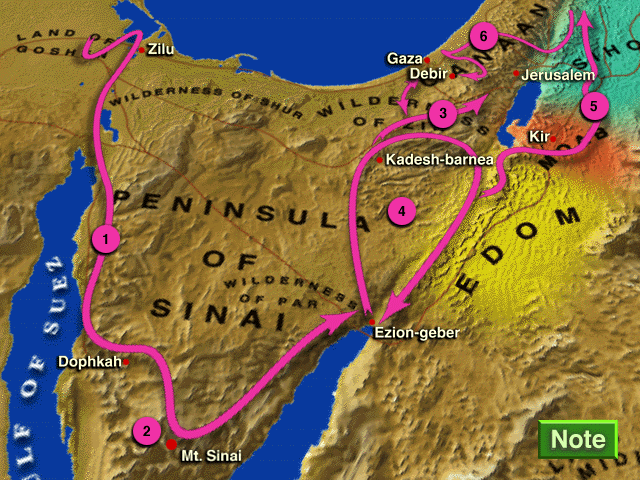
The chosen route shows that God’s plan was for the people to place their complete trust in Him. They were led along a path that first took them south to Sinai, and then toward Canaan, which was neither the most direct nor the easiest route. In the midst of the wilderness, God wanted the people not to rely on their own abilities to face life’s daily challenges, but to place everything in His hands. However, at the first material difficulty, the lack of food in the desert, the people did not show trust; instead, Israel’s response to this situation was to complain:
Then the whole congregation of the children of Israel complained against Moses and Aaron in the wilderness. And the children of Israel said to them, “Oh, that we had died by the hand of the Lord in the land of Egypt, when we sat by the pots of meat and when we ate bread to the full! For you have brought us out into this wilderness to kill this whole assembly with hunger.”
Exodus 16:2, 3
However, in the same situation, and faced with the tempter’s attack, Jesus did not complain; instead, overcoming the same challenge, His well-known response was:
But He answered and said, “It is written, ‘Man shall not live by bread alone, but by every word that proceeds from the mouth of God.’ ”
Matthew 4:4
It is notable that Christ’s words are a direct quotation from Scripture found in Deuteronomy 8, where the parallel of both the forty years and the hunger becomes even more evident.
And you shall remember that the Lord your God led you all the way these forty years in the wilderness, to humble you and test you, to know what was in your heart, whether you would keep His commandments or not. So He humbled you, allowed you to hunger, and fed you with manna which you did not know nor did your fathers know, that He might make you know that man shall not live by bread alone; but man lives by every word that proceeds from the mouth of the Lord.
Deuteronomy 8:2, 3
It is in this text from Deuteronomy that we see that Jehovah God led the people into the desert. In the same way, it is the Holy Spirit who leads Jesus into the desert. On the other hand, in the desert the people of Israel were to demonstrate their faith in God; however, in their weakness they murmured and complained. But it is in this very setting that Jesus overcomes, showing how the people should have responded. Christ’s response, quoting Deuteronomy 8:3, indicates that in His journey into the desert He is walking the path of Israel in perfection, serving as the model of what should and must be done.
The devil continued his assault against Christ, tempting Him with worship. Matthew and Luke indicate that
Again, the devil took Him up on an exceedingly high mountain, and showed Him all the kingdoms of the world and their glory. And he said to Him, “All these things I will give You if You will fall down and worship me.”
Then Jesus said to him, “Away with you, Satan! For it is written, ‘You shall worship the Lord your God, and Him only you shall serve.’ ”
Matthew 4:8-10
Then the devil, taking Him up on a high mountain, showed Him all the kingdoms of the world in a moment of time. And the devil said to Him, “All this authority I will give You, and their glory; for this has been delivered to me, and I give it to whomever I wish. Therefore, if You will worship before me, all will be Yours.”
And Jesus answered and said to him, “Get behind Me, Satan! For it is written, ‘You shall worship the Lord your God, and Him only you shall serve.’ ”
Luke 4:5-8
It is interesting that Deuteronomy 8, after indicating that Israel must keep the commandments and pointing toward the account of the forty years, states:
Then it shall be, if you by any means forget the Lord your God, and follow other gods, and serve them and worship them, I testify against you this day that you shall surely perish. As the nations which the Lord destroys before you, so you shall perish, because you would not be obedient to the voice of the Lord your God.
Deuteronomy 8:19, 20
Jesus, had he failed here, would have suffered the consequences that Deuteronomy indicates, he would have perished. However, he once again overcomes where the people did not. Israel repeatedly bowed before someone who was not God, but here Jesus, doing what the people in their journey could not do, responds to the tempter’s attack by once again quoting Deuteronomy:
You shall fear the Lord your God and serve Him, and shall take oaths in His name.
Deuteronomy 6:13
Finally, Jesus is also tempted by being taken to the pinnacle of the temple and urged to throw Himself down.
Then the devil took Him up into the holy city, set Him on the pinnacle of the temple, and said to Him, “If You are the Son of God, throw Yourself down. For it is written:
‘He shall give His angels charge over you,’
and,
‘In their hands they shall bear you up,
Lest you dash your foot against a stone.’ ”Jesus said to him, “It is written again, ‘You shall not tempt the Lord your God.’ ”
Matthew 4:5-7
Then he brought Him to Jerusalem, set Him on the pinnacle of the temple, and said to Him, “If You are the Son of God, throw Yourself down from here. For it is written:
‘He shall give His angels charge over you,
To keep you,’and,
‘In their hands they shall bear you up,
Lest you dash your foot against a stone.’ ”And Jesus answered and said to him, “It has been said, ‘You shall not tempt the Lord your God.’ ”
Luke 4:9-12
Jesus again cites Deuteronomy in His response to the temptation:
“You shall not tempt the Lord your God as you tempted Him in Massah.
Deuteronomy 6:16
The use of Deuteronomy on these three occasions shows us that Jesus was walking the path of Israel, but even more importantly, in what the people of Israel could not overcome, He did. That Christ faced the same path without sin demonstrates that He is our perfect substitute, and that we can trust in His merits and work.